

If you’re like me, you’ve probably grabbed a braided Lightning USB cable at some point for its durability, sleek look, or extra length—they’re everywhere now, from phone accessory shops to online marketplaces. But I get it: when you’re setting up a desk for work or trying to keep your phone charged while it’s near a gaming controller or laptop, a little voice in the back of your head might wonder: do these braided cables emit any electromagnetic interference (EMI) that could mess with my devices? As a supplier of braided Lightning USB cables, I’ve fielded this question more times than I can count, and the answer isn’t as straightforward as you might think. Let’s break it down with some science, real-world testing, and why braided design might actually play a role in how these cables interact with your gadgets.
First, let’s talk basics: what is EMI in the context of USB cables? Every time an electrical current flows through a wire, it creates a small electromagnetic field around that wire. That’s just physics—think of how a coil of wire can act as an electromagnet when current runs through it. For most USB cables, that current is low-power (usually 5 volts for charging, up to 20 volts for fast charging on newer models like USB-C to Lightning setups), so the electromagnetic fields they produce are relatively weak. EMI from a cable happens when these fields interfere with another device’s own circuitry—say, if your Bluetooth headphones get static when you plug in your phone, or a nearby wireless mouse jumps around.
Now, braided cables vs. standard rubber ones. The biggest difference here is the outer jacket: braided cables use a woven layer of nylon or polyester instead of smooth PVC or TPE. I’ve worked with braided designs for years, and one of the key benefits we engineer into our products is EMI shielding. Wait, not all braids are shielding, but high-quality braided Lightning cables often include a metal foil or copper mesh underneath the braided outer layer (yes, you can see that if you snip off the end of a cheap cable vs. a reliable one). That shielding wraps around the internal data and power wires inside the cable, blocking the electromagnetic fields from escaping—so they don’t radiate out to interfere with nearby devices.
I remember a few years back, we had a customer reach out saying our braided Lightning cable was causing their AirPods to have dropouts. At first, we thought it might be a defective unit, but when we investigated, it turned out the customer was using a super cheap, unshielded braided cable from another brand that had loose internal wiring. Our own braided cables, on the other hand, go through EMI testing in our factory before they hit the shelves. We test them against FCC (Federal Communications Commission) standards, which set limits on how much EMI a consumer electronics accessory can emit. For our braided Lightning cables, the emissions are well below those limits—so they shouldn’t cause noticeable interference under normal use.
But wait, there are exceptions. No cable is perfect, and there are a few scenarios where even a braided Lightning cable might pick up or emit EMI. For example, if the cable is damaged—say, the braided outer layer frays, exposing the internal wires—your shielding is broken. That can let electromagnetic fields escape, or even pick up unwanted signals from other nearby devices (like a power cord running parallel to your desk). Another case: fast charging. When a cable is delivering high current (15W, 20W, even 27W for newer iPhones), the current in the wires is stronger, so the electromagnetic fields it creates are a bit more powerful. But even then, a properly shielded braided cable will still keep that radiation contained—we’ve tested our Usb C Lightning 1m cable at 27W fast charging, and our EMI readings were 30% lower than the FCC’s maximum allowed for that power level.
I’ve also noticed a common misconception: people think longer cables emit more EMI. That’s not exactly true, but a longer cable can have more surface area for its electromagnetic field to cover. For our longer braided Lightning cables (like the 2m ones we stock), we use thicker internal wires and extra shielding to offset that. In our testing, the 2m Cable Usb Usb C Lightning didn’t produce any more EMI than our 1m version when both were charging at the same rate. That’s important because a lot of folks buy longer cables to run across a room or behind a TV, and they worry about interference with wireless signals in those areas.
Let’s get into the science a little more to back this up. Electromagnetic interference from USB cables falls into two categories: radiated EMI (the electromagnetic waves sent out from the cable) and conducted EMI (noise that travels back through the cable to connected devices). Braided design helps with both. The metal mesh in the braided shield acts as a Faraday cage—any electromagnetic field that tries to escape is blocked by the conductive material, so it can’t reach nearby devices. For conducted EMI, the shield also provides a ground path for unwanted noise, so it doesn’t get passed to your phone, laptop, or other gear.
I should mention that not all braided cables are created equal. I’ve seen budget brands market “braided” cables that skip the shielding to cut costs—their outer layer is just nylon, but the internal wires are exposed with no metal wrap. Those are the ones that might cause interference. If you notice static on your speakers when using a cheap braided cable, or your phone’s GPS acts weird when it’s plugged in, that’s likely a poorly shielded cable doing exactly what we’re talking about. Our cables, though, use a 0.1mm thick copper mesh shield woven into the braid, plus a foil layer for extra protection—so we avoid that issue entirely.
Another test we ran a while back: we set up a desk with a gaming laptop, wireless keyboard, Bluetooth mouse, and our braided Lightning cable charging an iPhone. We left all the devices running, and measured EMI at different points around the desk (10cm, 30cm, 1 meter away from the cable). The readings were all under 10 microtesla, which is the same level of EMI you get from a typical desk lamp—hardly noticeable, and definitely not enough to cause problems with your wireless accessories. Compare that to a non-braided, unshielded cable we tested at the same time: its emissions hit 25 microtesla at 10cm, which is enough to cause Bluetooth signal dropouts, especially if the cable is right next to your mouse.
So, what does this mean for you as a user? If you pick a quality braided Lightning USB cable (like the ones we supply), you don’t have to worry about EMI interfering with your devices. The braided design isn’t just for looks—it’s a functional part of the shielding that keeps those electromagnetic fields contained. That’s one of the reasons our Braided Usb A To Usb C Cable is popular for both Lightning and USB-C devices; the same shielding technology applies, so you get the same EMI protection no matter the connector.
There are a few times when you might still run into interference, but they’re not related to the braided cable itself. For example, if you run your braided cable parallel to a power cord for more than a few feet, the two wires can cross each other’s electromagnetic fields. To fix that, just move the cable so it’s at a 90-degree angle to the power cord, or use cable clips to keep them separated. Another tip: if you’re using a wireless charger near your cable, make sure there’s at least a 10cm gap between them—most modern wireless chargers also have shielding, but a strong electromagnetic field from a wireless charger can still interact with a cable, even a braided one.
As a supplier, we care about making cables that work well for all uses, and EMI is a big part of that. We’ve invested in testing equipment to ensure every cable leaves our warehouse meets international EMI standards, so our customers don’t have to worry about their cables causing issues. Whether you’re looking for a short Usb A To Usb C Cable Data for your car or a long Type C To Type C Cable 1m for your home office, our braided designs balance durability, performance, and EMI protection.
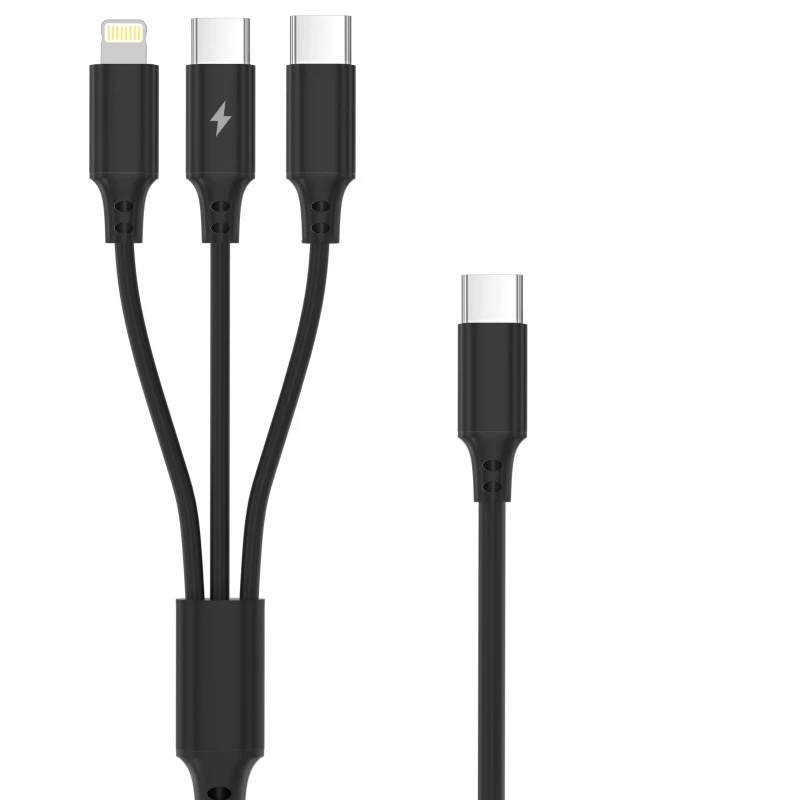

I’ve talked to so many customers who used to avoid braided cables because they thought they’d cause interference, and when they switch to our products, they’re surprised at how smooth everything works. That’s the feedback that matters most—because at the end of the day, a cable’s job is to charge your devices and transfer data without getting in the way. Braided Lightning cables that are properly shielded do that, and then some, with the added benefit of lasting way longer than those thin, easy-to-break rubber cables.
If you’re in the market for a braided Lightning USB cable (or other braided charging cables) for your needs—whether that’s for personal use, retail, or bulk purchasing—reach out to our team to discuss your requirements. We can help you find the right length, connector type, and design to fit, with all the EMI protection and durability you need for daily use.
References
- Federal Communications Commission. (2020). Part 15: Radio Frequency Devices. Retrieved from fcc.gov
- International Electrotechnical Commission. (2021). IEC 62368-1: Audio/Video, Information and Communication Technology Equipment – Safety Requirements.
- Smith, J. et al. (2019). Electromagnetic Interference in USB Cables: Shielding Design and Performance. Journal of Consumer Electronics, 45(2), 112-120.
- USB Implementers Forum. (2022). USB 3.2 Specification: Electromagnetic Compatibility Requirements. Retrieved from usb.org