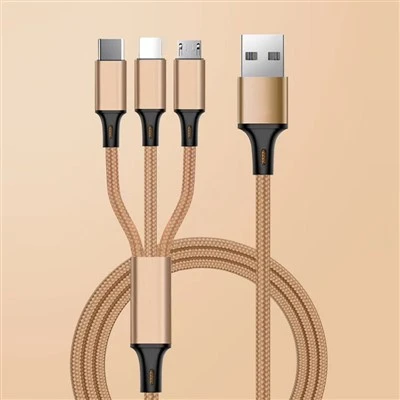


What Is a USB-A Charger?
A USB-A Charger uses the traditional rectangular USB-A connector that has been widely used for decades.
USB-A chargers are compatible with many legacy devices and continue to be found in homes, offices, and public charging stations.
Typical applications include:
- Older Smartphones
- Bluetooth Speakers
- Wireless Earbuds
- Power Banks
- Small USB Accessories
- Digital Cameras
Although USB-A remains widely used, its charging speed and power output are more limited than newer USB-C technology.
What Is a USB-C Charger?
A USB-C Charger uses the modern reversible USB-C connector, making it easier to connect devices without worrying about cable orientation.
More importantly, USB-C supports USB Power Delivery (PD), allowing significantly higher charging power and faster charging speeds.
USB-C chargers are commonly used for:
- Smartphones
- Tablets
- Ultrabooks
- MacBooks
- Gaming Consoles
- Wireless Earbuds
- Portable Monitors
- Power Banks
Today, USB-C has become the universal charging interface for most new electronic devices.
USB-A vs USB-C: Key Differences
Charging Speed
One of the biggest differences is charging performance.
USB-A chargers typically provide lower power output and slower charging speeds, while USB-C chargers with Power Delivery technology deliver much faster charging for compatible devices.
Power Output
USB-C chargers support a much wider power range.
Depending on the model, USB-C chargers are available in:
- 20W
- 30W
- 45W
- 65W
- 100W
This makes USB-C suitable for charging everything from smartphones to laptops.
Connector Design
USB-A connectors can only be inserted in one direction.
USB-C connectors feature a reversible design, allowing users to plug the cable in from either side for greater convenience.
Device Compatibility
USB-A remains compatible with many older devices.
USB-C, however, supports almost all modern smartphones, tablets, laptops, and many other consumer electronics, making it the preferred option for future-proof charging.
Comparison Table
|
Feature |
USB-A Charger |
USB-C Charger |
|
Connector |
Traditional USB-A |
Reversible USB-C |
|
Charging Speed |
Standard |
Fast Charging |
|
Power Delivery |
Limited |
USB PD Supported |
|
Laptop Charging |
No |
Yes |
|
Future Compatibility |
Moderate |
Excellent |
|
User Convenience |
Good |
Excellent |
Why USB-C Is Becoming the Industry Standard
Several factors have accelerated the adoption of USB-C chargers.
Faster Charging
USB-C supports USB Power Delivery, providing higher charging efficiency for modern devices.
One Charger for Multiple Devices
A single USB-C charger can power smartphones, tablets, laptops, earbuds, and many other electronic devices.
Better User Experience
The reversible connector makes charging more convenient while reducing connector wear.
Smaller and Smarter Chargers
Many USB-C chargers now use GaN technology, allowing manufacturers to produce smaller chargers with higher power output and better energy efficiency.
Which Charger Should You Choose?
The answer depends on your devices and charging needs.
Choose a USB-A Charger if:
- You mainly use older electronic devices.
- Fast charging is not a priority.
- You need basic charging for USB accessories.
Choose a USB-C Charger if:
- You own modern smartphones or tablets.
- You want faster charging speeds.
- You need to charge laptops.
- You prefer one charger for multiple devices.
- You want a future-ready charging solution.
For most users today, USB-C offers greater flexibility, higher performance, and better long-term value.
Why Choose an OEM & ODM Charger Manufacturer?
An experienced OEM & ODM manufacturer can help brands develop charging products that meet global market demand.
Professional manufacturing services include:
- Product Design
- OEM & ODM Services
- Private Label Manufacturing
- Logo Printing
- Customized Packaging
- Product Testing
- Quality Inspection
- Certification Support
- Stable Production Capacity
These services enable customers to launch competitive charging products while maintaining consistent quality.
Future Trends
The transition from USB-A to USB-C is expected to continue as more devices adopt USB-C charging ports.
Key market trends include:
- USB-C Power Delivery
- GaN Fast Chargers
- Multi-Port USB-C Chargers
- Retractable Charging Solutions
- Magnetic Wireless Chargers
- Sustainable Product Design
Manufacturers that focus on USB-C technology will be better positioned to meet future market demand.
Conclusion
When comparing USB-A vs USB-C Charger, USB-C clearly offers significant advantages in charging speed, power output, convenience, and compatibility.
While USB-A remains useful for legacy devices, USB-C has become the preferred charging solution for modern consumer electronics and is expected to dominate the market for years to come.
For brands, wholesalers, and distributors, investing in high-quality USB-C charging products is a smart strategy for long-term business growth.
Contact Us
Looking for a reliable OEM & ODM manufacturer of USB-A chargers, USB-C chargers, GaN chargers, retractable chargers, wireless chargers, and charging accessories?
Our experienced team provides innovative charging solutions, flexible customization, and dependable manufacturing services for customers worldwide.
Contact us today to discuss your project and receive a fast quotation within 24 hours.